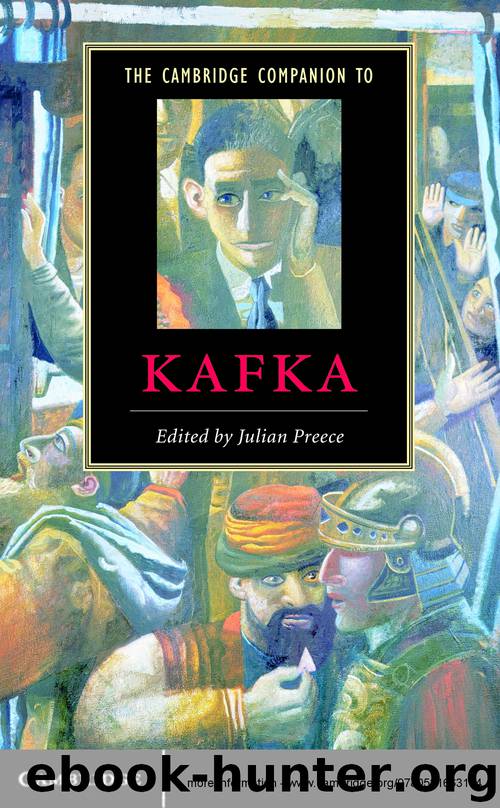
The Cambridge Companion to Kafka by Julian Preece
Author:Julian Preece
Language: eng
Format: epub
Publisher: Cambridge University Press
Published: 2002-03-21T16:00:00+00:00
He briefly opens the window to the world or glances quickly through it only to shut it quickly again or pull the curtains. But that does not mean he was unaware of what was going on outside.
The Jewish theme takes up some of the most delicate but also amusing and sometimes trenchant passages in the Letters to Milena. In the letters to Brod he returns to the way he is treated as a Jew in Matliary and elsewhere. Allegiance and identity were all-consuming preoccupations at the time when the multilingual, multicultural Austro-Hungarian empire was broken up, and the little nations, which had been subjects of the Kaiser, the Emperor, or the Tsar, formed themselves into states. In letters to Brod and Ottla from Matliary, he dissects the demographic make-up of guests and inhabitants – Slovaks, Hungarians, German-speakers, Jews. The break-up of the empire affects the plan to meet Milena for a night and a day in the border town of Gmünd, when suddenly arrangements for passports and border crossings in the new frontier town become symbolic of their difficulties in communicating with one another. In other respects current affairs or world events indeed bothered him very little. The link between Kafka and his times, which is similar to that between his literary work and his biography, has to be found elsewhere. It is surely located in his unique talent for observation, his ability to interpret gestures, comments, appearances to give them social, psychological, and metaphorical meaning.
His diaries, sometimes the sketchpad for his fictions, sometimes an outlet for his feelings, a private vehicle for self-expression, are less voluminous and take second place to his letters or literary writing. Often he uses the diary notebook for a fictional narrative, which possibly shows how the diary and the fictions went together, or it shows, more prosaically, that the diary notebook was the first paper he had to hand when he wanted to write. Whether in letters or in diaries, he seems to be always reporting on his dreams which he has a knack for remembering completely. There are themes and figures, images and situations, animals, which recur in the diaries’ mini-narratives and fragments of narratives. We cannot know how Kafka would have prepared them for publication had he wanted to do so and had he lived. They are raw and in the wrong order because he used two or more notebooks at any one time for reasons which are not always apparent – and why should they be? Does an editor put them into chronological order and make a readable book out of them, as Brod did? If some readers get impatient with the uneven quality and eclectic nature of the entries and Kafka’s inconsistent approach, others will see perfection in the imperfection. We get a glimpse not just of his private preoccupations but insight into how his creative mind works. The sequence which includes the first mention of Josef K. on 29 July 1914 shows him groping towards something after the dramatic bust-up with Felice in Berlin in the middle of the month.
Download
This site does not store any files on its server. We only index and link to content provided by other sites. Please contact the content providers to delete copyright contents if any and email us, we'll remove relevant links or contents immediately.
Cecilia; Or, Memoirs of an Heiress — Volume 2 by Fanny Burney(31966)
Cecilia; Or, Memoirs of an Heiress — Volume 3 by Fanny Burney(31947)
Fanny Burney by Claire Harman(26611)
We're Going to Need More Wine by Gabrielle Union(19059)
Plagued by Fire by Paul Hendrickson(17420)
All the Missing Girls by Megan Miranda(16066)
Cat's cradle by Kurt Vonnegut(15379)
For the Love of Europe by Rick Steves(14197)
Bombshells: Glamour Girls of a Lifetime by Sullivan Steve(14086)
Leonardo da Vinci by Walter Isaacson(13347)
4 3 2 1: A Novel by Paul Auster(12411)
The remains of the day by Kazuo Ishiguro(9010)
Adultolescence by Gabbie Hanna(8933)
Note to Self by Connor Franta(7675)
Diary of a Player by Brad Paisley(7598)
Giovanni's Room by James Baldwin(7360)
What Does This Button Do? by Bruce Dickinson(6211)
Ego Is the Enemy by Ryan Holiday(5461)
Born a Crime by Trevor Noah(5387)
